Measured energy

A school is empty for more hours than it is full: afternoons, weekends, holidays. Yet many school heating systems follow a fixed timetable, the same for the whole building. Heating to the real timetable is the first step to spending less.
Good school heating scheduling has an advantage over almost any other building: the timetable is known in advance, for the whole year. You know when lessons start and finish, which afternoons the gym is used by a sports club, and when the Christmas and Easter holidays fall.
Yet many school heating systems run on a single schedule set years ago: on from six to two, Monday to Saturday, for the whole building. Offices open in the afternoon are cold, empty classrooms on Saturday are warm, and the gym is heated even when nobody uses it. In this article we look at how to heat a school to its real timetable.
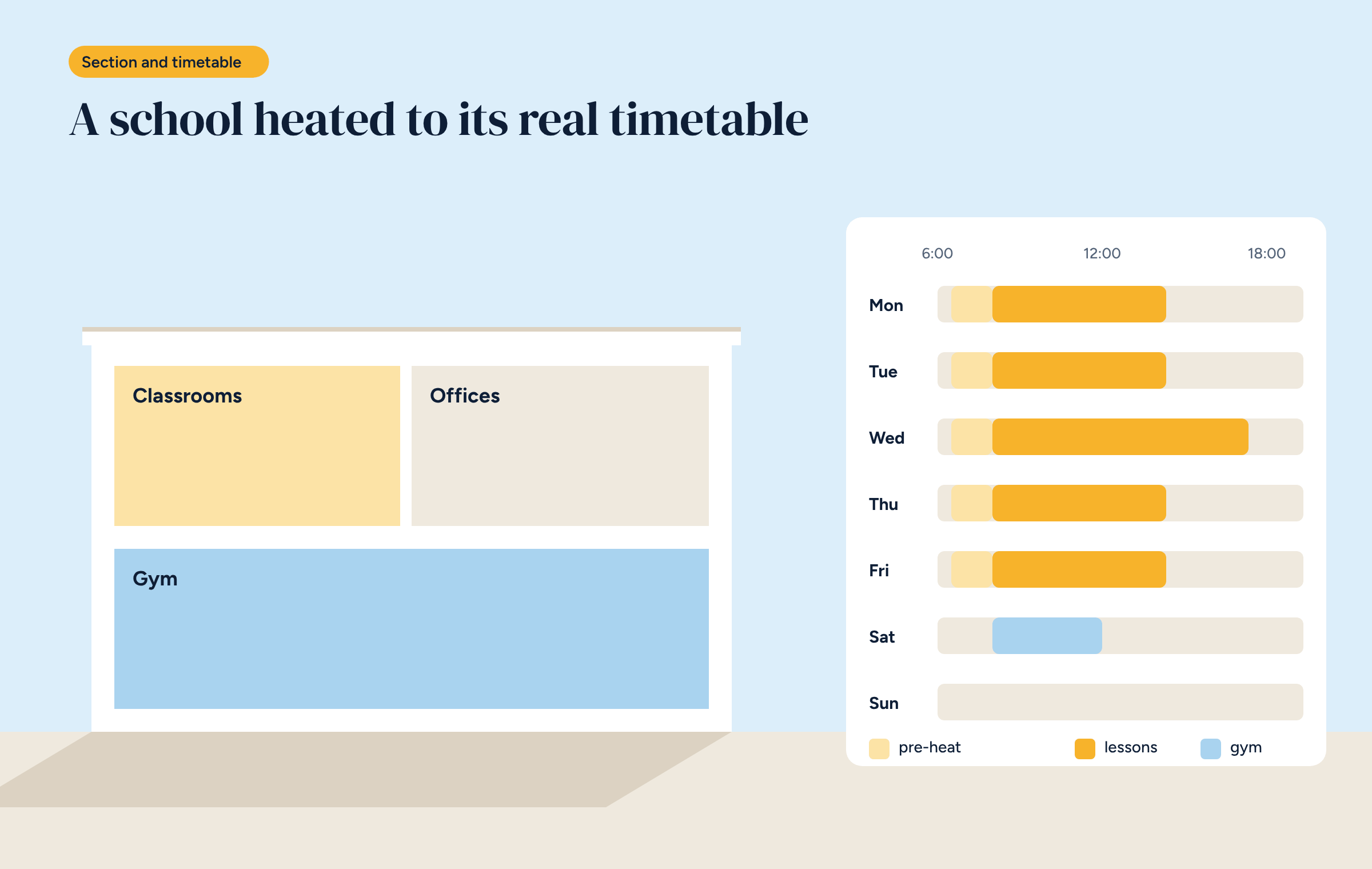
The starting point is the calendar, which in a school has three levels.
A good control system handles all three: a weekly schedule per zone, exceptions for extra uses, and a closure calendar that puts the building into set-back or frost protection.
Many countries regulate how long heating may run in public buildings, and at what temperature. In Italy, for example, a national decree sets the heating season and the maximum daily hours for each climate zone, and caps room temperature at 20 °C with a small tolerance. Similar rules exist elsewhere, often in public sector energy policies.
Whatever the rules, the hours available have to be used well in a large building with plenty of thermal mass: start too early and you waste hours, start too late and classrooms are cold for the first lesson. A controller that logs running hours also helps prove the limits are respected.
A school with thick walls, or with underfloor heating, needs time to warm up. On Monday morning, after two days at set-back, it needs much longer than on Tuesday.
The answer is variable pre-heating: the controller works out when to start based on outdoor and classroom temperatures, so the rooms reach temperature as lessons begin and not before. In the first few weeks you watch the building and refine the timings; then the system learns.
A school building has at least three kinds of space with different needs, and deserves at least three zones.
In larger schools it pays to separate wings and floors too, especially if they face different ways. It is the same principle as zone control in a home, which we discussed in the article on zone control savings, applied on a larger scale.
Holidays are when a school wastes the most without anyone noticing. Two weeks at Christmas, one at Easter, bridge days: days when the building is empty but the system, if nobody changed the schedule, runs as on a school day.
With a closure calendar loaded at the start of the school year, the building drops by itself to deep set-back or frost protection, and pre-heating restarts in time for the return. Only the office zones stay active on the days the administration is open. It is one of the simplest measures, with the quickest payback.
In a school, different people with different skills use the system.
Each has their own user and permissions: the caretaker should not be able to change the heating curve, and the contractor should not have to call someone to see a chart.
For an authority that manages many buildings, consumption data is a management tool. It lets you compare schools, spot the one using twice as much for the same floor area, check the result of an upgrade and prepare funding applications.
You need the basic plant room readings described in the article on the six readings in a plant room, and a simple way to export them, as explained in the article on exporting your data. With a local system, the data stays with the authority, not with a supplier.
Public bodies can often access dedicated funding for energy efficiency in buildings, and building automation is increasingly part of it. In the EU, the Energy Performance of Buildings Directive also requires building automation and control systems in larger non-residential buildings, as we explained in the article on class B building automation. The details vary from country to country and should be checked at project stage.
For a public body one requirement matters as much as savings: not depending on a single supplier. A closed system, with one authorised installer and licences to renew, ties the authority down for many years, with all the difficulties of a forced procurement route. An open system can be maintained under normal maintenance tenders, by any qualified contractor. That is the theme of the article on the authorised installer, and for a school it matters even more.
For local authorities, schools and public buildings: a site visit to see how the system works today and which zones and schedules it needs.