From panel to data

Underfloor systems can cool in summer, quietly and comfortably. But in southern Europe the air is hot and humid, and a floor that gets too cold gets wet. The secret is one number: the dew point.
Underfloor cooling is one of the most pleasant ways to get through summer: no draughts, no noise, an even coolness rising from below. With a reversible heat pump, the same system that heats in winter cools in summer.
In southern Europe, though, there is an enemy: humidity. In Bari, Seville or Athens in July, the air is hot and full of moisture. If the floor gets colder than a certain threshold, the moisture condenses on its surface, like on a glass of iced water. The floor gets wet and slippery underfoot, and over time parquet and adhesives are damaged. Managing underfloor cooling condensation and the dew point is a control job, so let’s see how to do it.
Air contains water vapour, and the warmer it is, the more it can hold. Relative humidity tells you how much vapour there is compared with the maximum possible at that temperature.
When air touches a cold surface it cools. If it drops below a certain temperature it can no longer hold all its vapour, and some is deposited as water. That temperature is the dew point, and it depends on two things: air temperature and humidity.
For underfloor cooling there is one rule: the floor surface must always stay warmer than the dew point of the room air, with a margin.
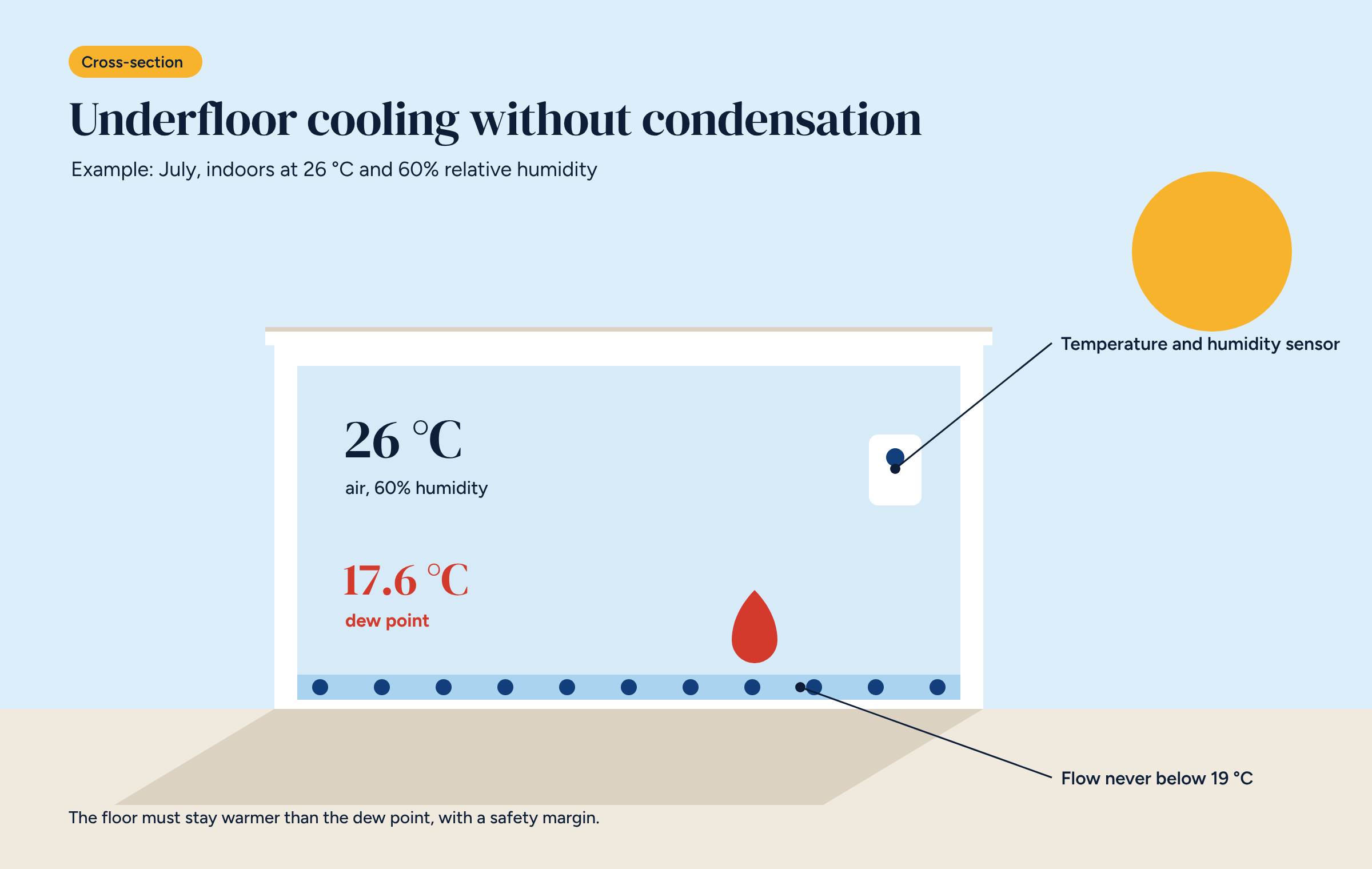
Take a room at 26 °C with 60% relative humidity, a common condition in a southern Italian home in summer. The dew point is about 17.6 °C.
That means any surface below 17.6 °C in that room will get wet. If the system flow reaches 16 °C, the pipes and the floor above them will drop below that threshold. If the flow stays above 19 °C, with a margin of about one and a half degrees, the floor stays dry.
But humidity changes: when people cook, shower or gather in numbers, 60% becomes 70% and the dew point rises to about 20 °C. So the limit cannot be fixed: it must be recalculated continuously.
The solution is to measure. Every cooled zone, or at least the riskiest rooms such as kitchens and bathrooms, needs a temperature and humidity sensor. The controller calculates each room’s dew point, takes the highest, and sets the minimum flow temperature a margin above it, usually one to two degrees.
In practice the cooling flow temperature is decided by two rules together:
The second always wins. If the limit is higher than comfort would require, the room will be a little less cool, but dry.
There is often an independent safety device too: a condensation sensor strapped to the flow pipe, which stops cooling if it detects moisture on the surface.
If the condensation limit stops the floor from cooling enough, the answer is not to lower the flow temperature: it is to take moisture out of the air. Less moisture means a lower dew point, and so a cooler flow without risk.
There are two ways.
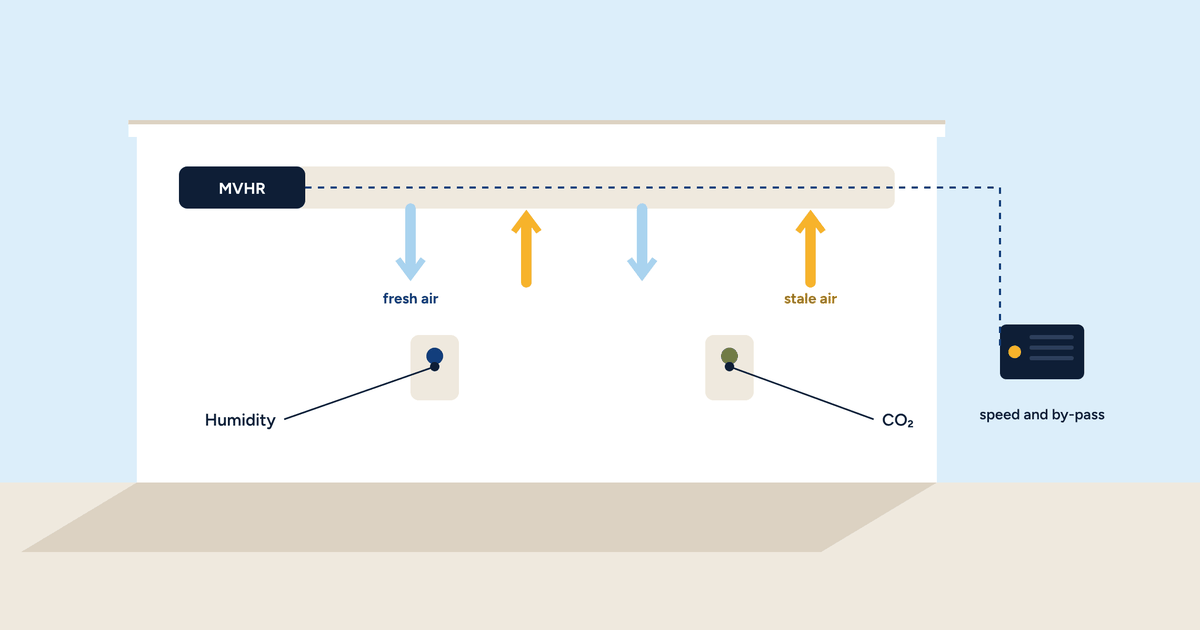
Either way, they are best controlled by the same controller that runs the floor: they switch on when humidity rises and when the condensation limit is holding back the cooling.
An underfloor system cools less than it heats. With the flow temperatures the dew point allows, cooling output is roughly 30–40 watts per square metre, and the surface temperature cannot drop too far either, for the comfort of bare feet.
In rooms with large west-facing windows, or on very hot days, it may not be enough. Then the floor provides the base load and a fan coil handles the peaks and dehumidifies, as we saw in the article on fan coils. It is the most effective combination in hot climates, and the one we see working best in southern Italian homes.
Switching from heating to cooling needs care:
In Brick’s configurations, Zigbee temperature and humidity sensors measure every zone, and the controller recalculates the dew point continuously. The cooling flow follows its curve but never drops below the limit, which updates with every reading. If humidity rises too far, dehumidification or MVHR switch on, if present, and an alert goes out.
Everything shows in the Grafana charts: temperature, humidity, dew point and flow on the same timeline. It is the easiest way to see, in the first weeks of summer, whether the margin is right or can be reduced.
Underfloor cooling works very well in hot climates, on one condition: the controls must know each room’s humidity, not just its temperature. Without humidity sensors, radiant cooling should not be switched on at all. It is the summer companion to our guide to underfloor heating control.
Brick’s configurations handle heating and cooling, with Zigbee humidity sensors and a flow limit calculated from the dew point.