From panel to data

Mechanical ventilation with heat recovery is now common in new homes and deep renovations. But it often runs on its own, with its own controller, ignoring what the heating and cooling are doing. Integrating it improves air quality and cuts energy use.
MVHR, mechanical ventilation with heat recovery, changes a home’s air continuously: it extracts stale air from kitchens and bathrooms and supplies filtered outdoor air to bedrooms and living areas. The outgoing air gives most of its heat to the incoming air, so the ventilation costs little energy.
It is a valuable system, especially in well-insulated homes, where humidity and CO₂ build up quickly without ventilation. But MVHR often has its own wall controller, with three speeds and a schedule, and nothing coordinates it with the rest. Let’s look at MVHR control integration with the heating and cooling.
A heat recovery ventilation unit has three main parts:
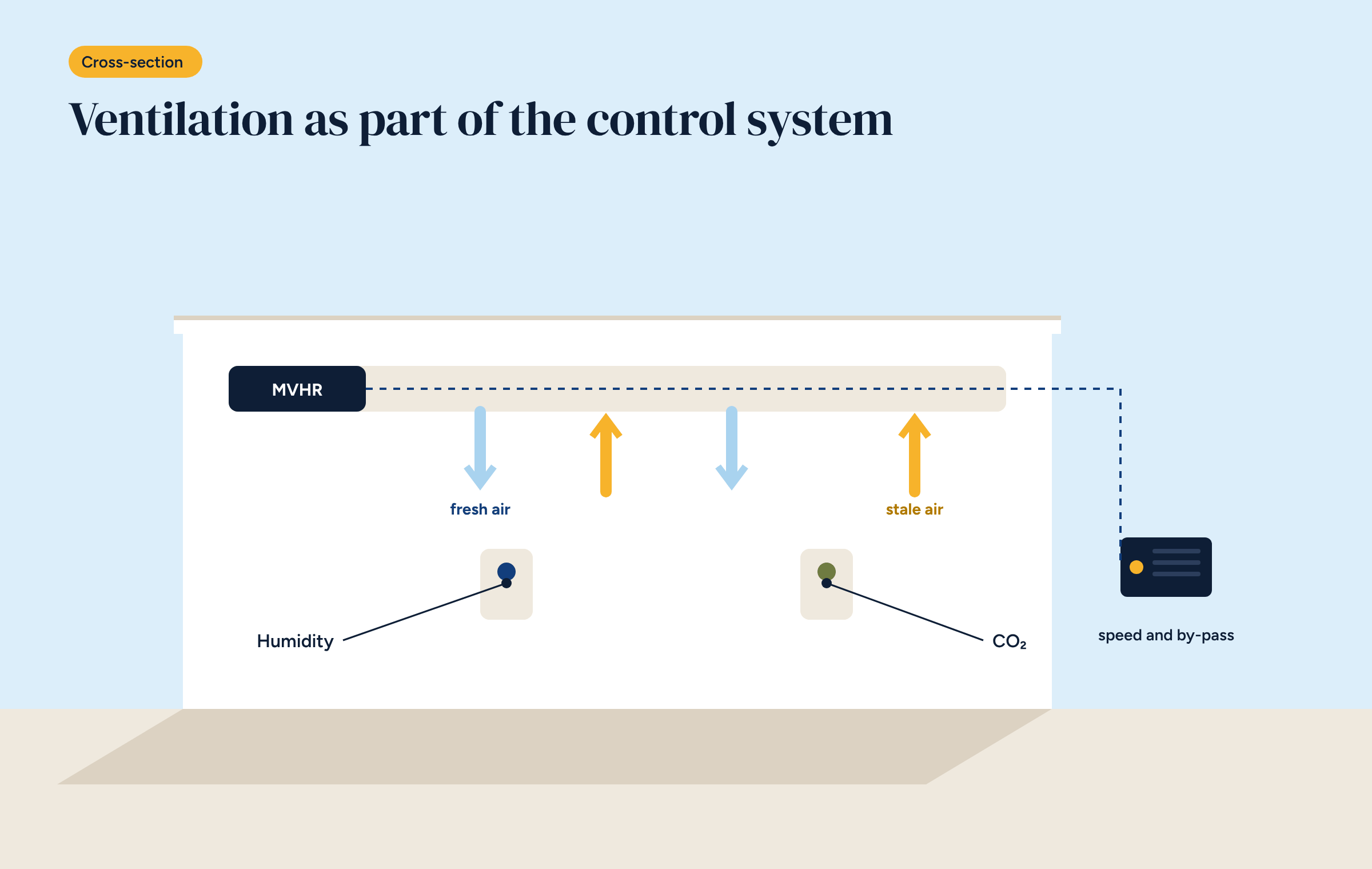
Many units also have a bypass, which lets outdoor air skip the exchanger: useful in summer, when the night air outside is cooler than inside and there is no point warming it.
An MVHR unit can be controlled in three ways, depending on the model.
Stepped speeds. Three or four contacts, one per speed, as on a fan coil. It is the simplest control and the most common on domestic units.
0–10 V signal. The speed varies continuously. Airflow can match real demand, with less noise and lower consumption.
Modbus. On more advanced units, the controller reads temperatures, filter status and alarms, and writes speed, bypass and operating modes. It is the most complete connection, with the manufacturer’s register map as the key document, as for the heat pumps covered in the article on protocols.
An MVHR unit always running at the same speed does too little when the house is full and too much when it is empty. Sensors decide how much to ventilate.
The Zigbee temperature and humidity sensors already used for the zones, as we saw in the article on underfloor cooling, also serve the MVHR. CO₂ needs a dedicated sensor.
In summer, MVHR can help a great deal, or make things worse.
Night bypass. When it is cooler outside than inside at night, the bypass opens and brings cool air in without recovering heat. It is almost free cooling.
During the day, with hot, humid outdoor air, it is better to ventilate at the minimum needed, with the exchanger active: the incoming air cools a little by giving heat to the outgoing air.
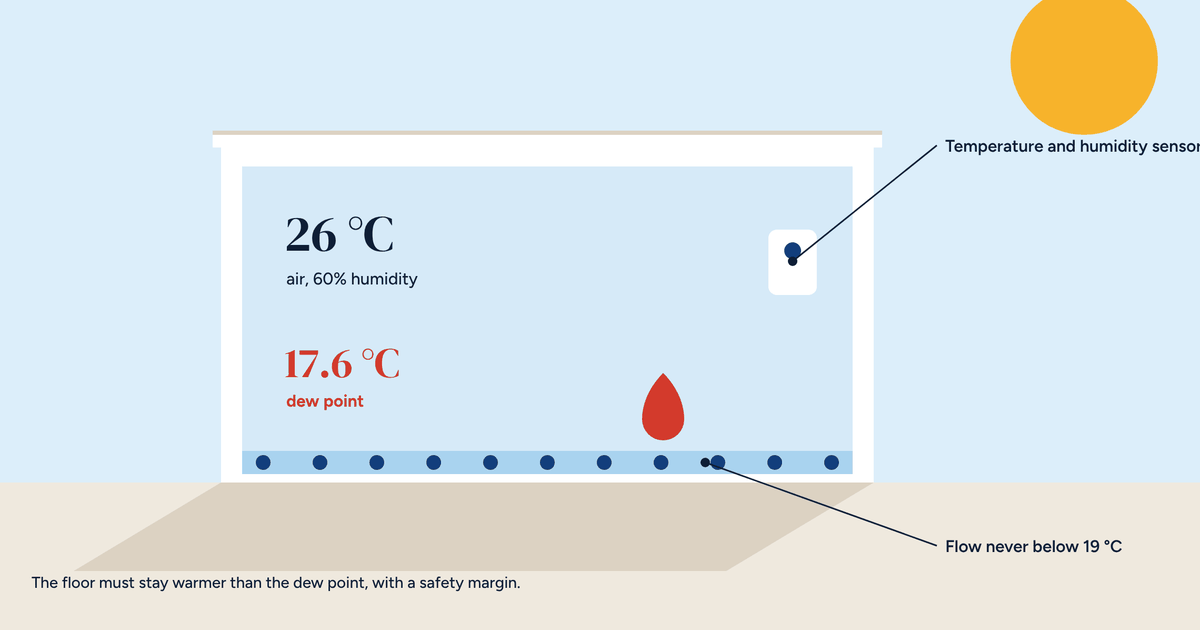
Dehumidification. Many MVHR units have a dehumidification module, sometimes with a coil fed by the system’s chilled water. Coordinated with underfloor cooling, it lowers the dew point and so allows more cooling without condensation.
In winter MVHR recovers heat, but in very cold weather the exchanger can freeze. Units have frost protection, which reduces airflow or pre-heats the incoming air. The controller needs to know, so it doesn’t mistake reduced airflow for a fault.
Comfort also depends on where the air arrives: a cold supply above a bed is unpleasant. A control system that knows each room’s temperature can reduce ventilation in bedrooms when they are already at the low limit, and increase it in a crowded living room.
Dirty filters reduce airflow, raise fan energy use and, over time, worsen air quality. Many units report filter status, through a contact or a Modbus register. Others don’t, and then a running-hours counter with a due-date alert is used.
Either way, it pays to bring the alert into the controller along with the others, so it reaches whoever handles maintenance.
Each of these is easy to spot in the charts once the unit is part of the control system, and easy to correct.
For a home with MVHR, underfloor heating and cooling, a sensible logic is:
It takes a few lines in a Node-RED flow, and it changes how the house breathes.
Every Brick configuration, as well as heat sources, pumps, zones and domestic hot water, can manage mechanical ventilation. The controller coordinates it with heating and cooling, uses the same sensors as the zones and logs the data in Grafana. In systems with fan coils, the logic combines with the one described in the article on fan coils: MVHR brings in the fresh air, the fan coil conditions it.
Every Brick configuration can also manage mechanical ventilation. Try the configurator or send us your system diagram.