From panel to data

The fan coil is the most common emitter in offices, hotels and many homes in southern Europe, because it heats in winter and cools in summer. Controlling it well means getting fan speed, valve and season right together.
A fan coil unit is a simple device: a coil carrying hot or cold water, a fan pushing room air through the coil, and a tray for condensate. In winter it heats, in summer it cools and dehumidifies. It responds in minutes, unlike underfloor heating.
Precisely because it is quick, a badly controlled fan coil is noticed straight away: noise, draughts, rooms swinging between too hot and too cold. Let’s look at 3-speed fan coil control done properly, starting with the most common type.
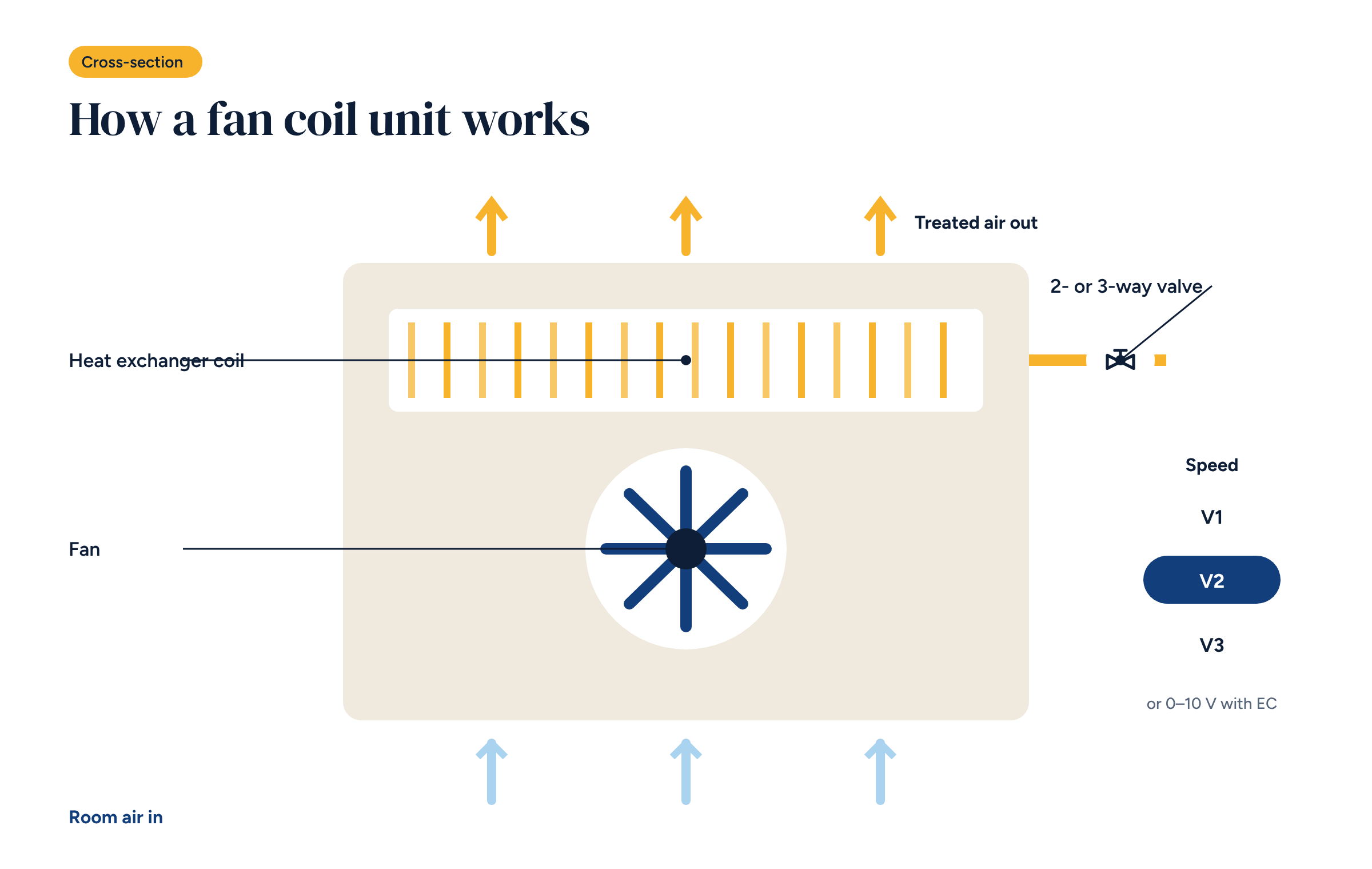
The fan motor has three windings, one per speed. One winding at a time is powered through a relay: V1 low, V2 medium, V3 high. It is essential that the relays are interlocked, so that two speeds can never be powered at once. Proper wiring diagrams always include this, and it is worth checking on site.
The heat delivered depends on two things: the airflow, meaning the speed, and the temperature of the water in the coil, which depends on the valve. So a good fan coil controller does not just control the fan: it controls fan and valve together.
Fan only. The valve is always open, or missing altogether, and the thermostat switches the fan on and off. It is the cheapest solution and the worst: the coil stays hot even when the fan stops, so the room keeps receiving heat by convection, and the circuit runs all the time.
On/off valve and stepped speeds. The valve opens when the zone calls for heating or cooling. The speed rises with the distance from the set point: V1 when the room is close to the right temperature, V2 a little further off, V3 only at start-up or with large differences. It is the most common control strategy, and it works well if the thresholds are set carefully.
Modulating valve and 0–10 V fan. The valve opens in proportion to demand and the fan, with an EC motor, runs at exactly the speed needed. It is the quietest and most efficient option, but it requires fan coils with EC motors and modulating valves.
The choice of valve depends on the system more than on the fan coil.
Either way, a valve that opens only when the zone asks for it stops the fan coil heating or cooling with the fan off.
A fan coil works in two seasons, and the controls need to know which.
Changeover. In 2-pipe systems the same water is hot in winter and cold in summer. The controller must know the season to reverse the logic: in winter it opens when the room is cold, in summer when it is warm. Changeover can be manual, centralised in the controller, or automatic with a sensor on the pipe.
Dead band. In 4-pipe systems, where heating and cooling are available at the same time, you need a dead band between the two set points, say 21 to 25 °C, within which the fan coil does nothing. Without it you risk heating and cooling the same room in the same hour.
Condensate. When cooling, the cold coil condenses moisture from the air. The tray and drain must work, and if there is a condensate pump, its alarm is worth wiring to the controller.
EC (electronically commutated) motors use much less electricity than 3-speed motors, especially at low speeds, where a fan coil spends most of its time. They are also quieter and allow continuous control.
They are always worth choosing in new systems. In upgrades, consider them when there are many fan coils running long hours, as in a hotel or an office open all day, or when noise is a problem. Where fan coils run little, a good 3-speed control with an on/off valve remains a reasonable solution. Either way, plan the change together with the controls: an EC motor driven by a simple on/off thermostat delivers only part of its benefits.
There are two Brick configurations for fan coils. B3 controls up to 8 three-speed fan coils with Zigbee sensors and actuators and control from the app. B5 adds a Zigbee controller in each room, so the temperature can also be changed from the wall. For mixed systems with underfloor heating and fan coils, including EC motors, there is C0 with Modbus controllers. In all of them, the controller coordinates the fan coils with the pump and heat source, and logs the data for Grafana.
Where fan coils work alongside underfloor heating, the rule is simple: the floor does most of the work, the fan coil handles peaks and dehumidifies in summer. We covered this in the guide to underfloor heating control.
Configuration B5 controls up to 8 fan coils with a Zigbee controller in each room and the app. Download the wiring diagram and adapt it to your system.