Open by choice

When we propose a system built on free software, the objections are almost always the same five. They are fair doubts, and they deserve precise answers, not slogans. We have gathered them here, one by one.
Free software is everywhere: in the servers that run the internet, in Android phones, in cars, in banks’ systems. Yet when it enters a heating system, it is met with suspicion. That is understandable: for years building controls were a world of closed systems, and free software looked like something for hobbyists.
Open source in building systems raises fair questions, and some open source building automation myths deserve a straight answer. In this article we gather the five we hear most often from engineers, installers and owners, with the answers we give. We have already explained why Brick uses free software in the dedicated article; here we answer the doubts.
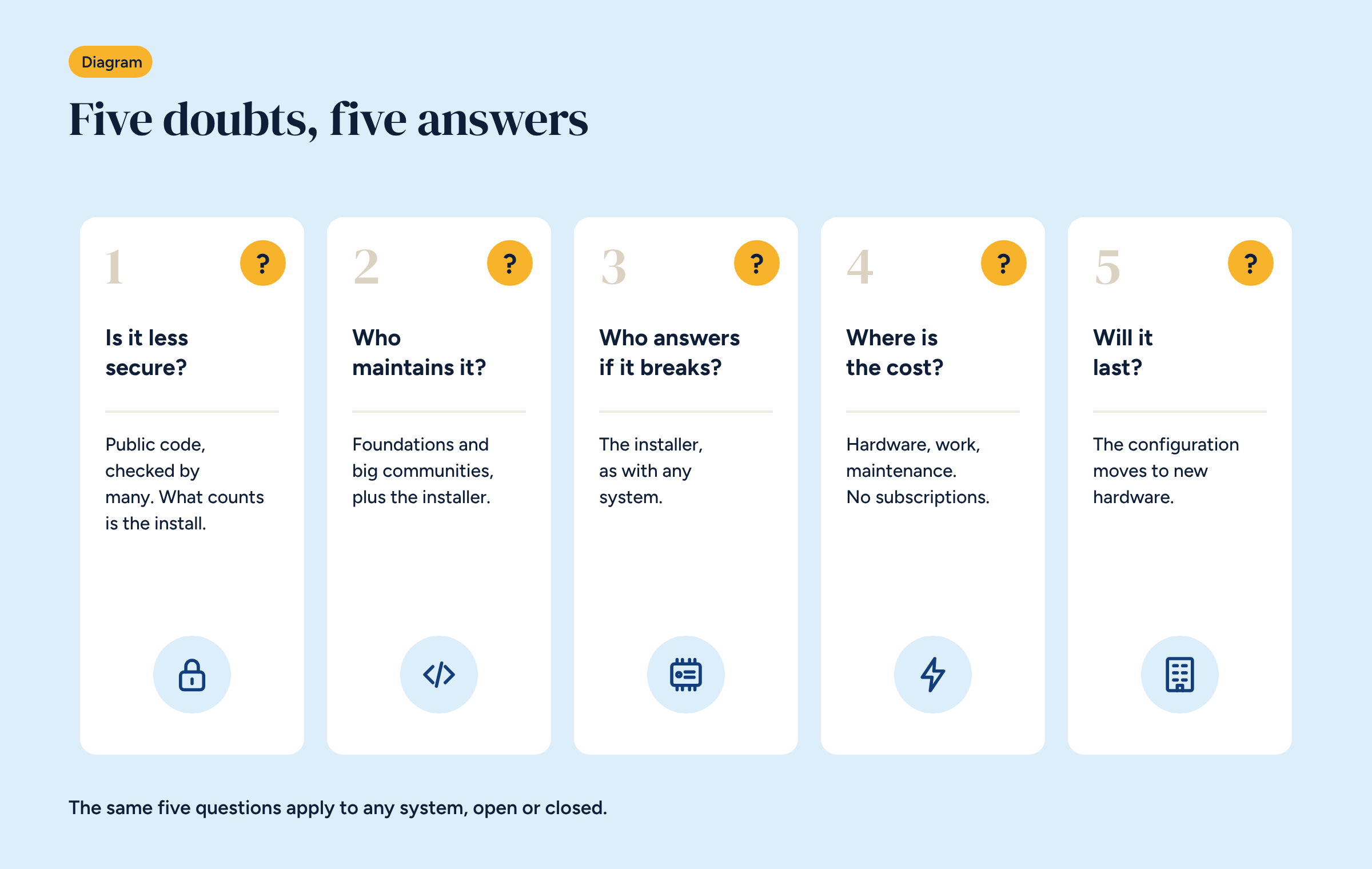
The fear is understandable: if the code is public, anyone can look for its weak points. But the opposite is also true. Public code is read and checked by far more people than secret code, and flaws, once found, are fixed quickly and in the open. It is no coincidence that free software underpins much of the world’s most critical infrastructure.
In a building system, security depends mainly on how it is installed. A separate network for the system, personal passwords, planned updates, no ports open to the internet: these are the rules we described in the article on minimum security rules, and they apply to any system, open or closed. A closed system with a factory password and an open router port is far less secure than a well-installed open one.
The worry is that free software is written by volunteers who might give up at any moment. For Brick’s components, that is not the case.
Home Assistant is developed by a very large community and coordinated by the Open Home Foundation, a non-profit, with a new release every month. Node-RED is a project of the OpenJS Foundation, which also looks after some of the tools web developers use most. Linux and Grafana need no introduction. These are projects with thousands of contributors and companies that use and fund them.
On top of that comes maintenance of the installed system, done by the installer, and maintenance of the ready-made configurations, done by us.
This is the most important question for buyers. The answer is the same as for any building system: whoever installed it is responsible, backed by the component warranties and the maintenance contract.
Brick’s hardware has its own warranty. The ready-made configurations are supported by ETECH LAB. The installer answers for their work, as with a boiler or an electrical panel. Free software removes none of these responsibilities: it makes them more transparent, because every change can be documented and checked.
The real difference lies elsewhere: if the installer is no longer around, the system is not orphaned. Any other professional can take it over, as we described in the article on the authorised installer.
The software is free, but a building system is not. The cost sits where it should:
What is missing are the items that add no value: annual licences, app subscriptions, fees to unlock features that are already there. That is why, over ten years, an open system often costs less than a closed one, even if it costs more at the start.
A building system lasts twenty years. Nobody can guarantee that any single product, open or closed, will still be on sale in twenty years. The right question is different: what happens when it isn’t?
With a closed system, when the manufacturer stops supporting a model, the controls often have to be redone. With an open system the configuration is exported and moved to new hardware, because the software belongs to no one exclusively. Data remains readable, protocols remain standard, skills remain widespread.
It is the same logic that makes free software so common in infrastructure: not depending on the fate of a single company.
The five doubts have one merit: they can be put to any system, not just open ones. Before choosing a control system, it is worth asking the supplier, in writing:
Side by side, the answers say far more than any datasheet. And they help compare open and closed systems by the same yardstick.
A sixth question comes up now and then: “Are there technicians who know how to use it?” Home Assistant is the most widely used open-source home automation software in the world, and the number of integrators who know it grows every year. For installers coming from heating systems we have designed a dedicated pathway, with no need to become programmers. And for remote access and maintenance, the same rules apply as for any professional system, as explained in the article on remote access to Home Assistant.
We summed all this up in the third video of our series, which you can watch below. One key only, held by the authorised installer, against one key for everyone: an open system can be entrusted to whoever you choose. It lasts under a minute and is aimed at decision-makers, owners, managers and engineers, more than at technicians.
The Brick page covers the hardware, the software and the purchase options. If you have a doubt that isn’t in this article, get in touch.