Your data stays yours
The purchase price is the number everyone looks at, and the one that tells you least. A control system stays in a building for ten, fifteen, twenty years: over that time, subscriptions, replacements and changes to the service are what count.
When choosing a thermostat or a control system for a building, the comparison is almost always made on purchase price. That is understandable: it is the only number printed in large type. But the smart thermostat subscription cost, and everything else that comes after the purchase, often matters more. A control system is not an appliance you replace after five years. The actuators on the manifold and the sensors in the rooms can stay put for twenty years, and whatever controls them should last at least ten.
In this article we suggest a simple method for comparing costs over ten years, with three example scenarios. The figures are assumptions: they illustrate the reasoning, they are not a quote.
The cost of a control system over ten years is the sum of five items.
The first two are known at the time of purchase. The other three are not, and that is where systems really differ.
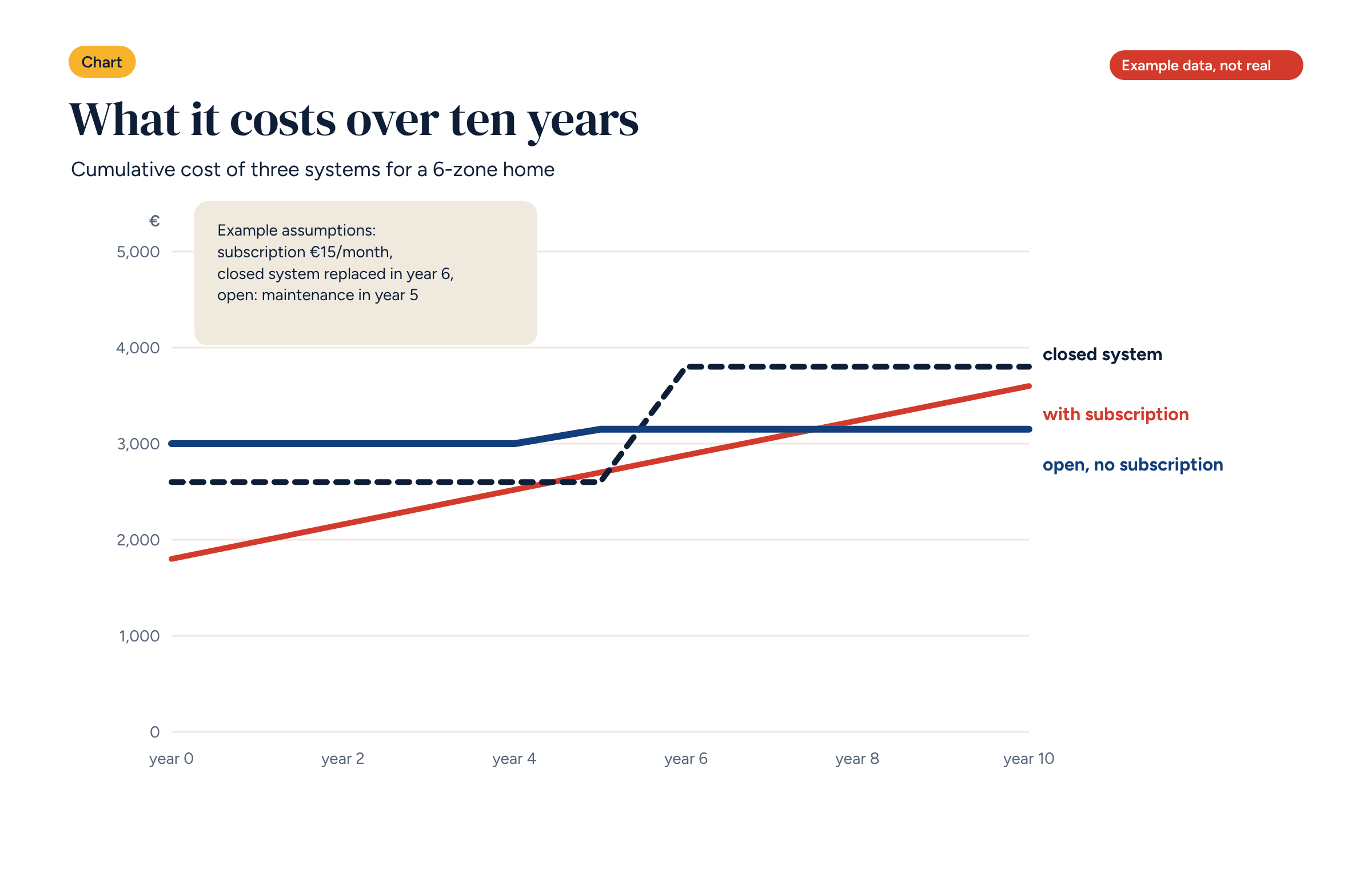
Take a home with underfloor heating and 6 zones, and three example systems.
System A, with a subscription. Cloud-connected smart thermostats. Cheapest at the start: €1,800 for devices and installation. Zone management and consumption history require a subscription of €15 a month, or €180 a year. Over ten years the total reaches €3,600.
System B, closed. A proprietary system installed by an authorised partner. It costs €2,600 up front. In year six the central unit drops out of manufacturer support and must be replaced, at €1,200 for equipment and labour. Over ten years: €3,800.
System C, open and subscription-free. A controller running free software. It costs more at the start, €3,000, because it includes the panel and plant room control. In year five, a maintenance visit with an update: €150. Over ten years: €3,150.
The system that cost most on day one is the one that costs least after ten years. With other assumptions the numbers change, but the pattern stays similar: recurring costs, even small ones, add up year after year, and forced replacements weigh heavily.
The chart leaves out one item: risk. A subscription can go up. A service can close, as has happened to several home automation brands; we described some cases in the article on home automation without the cloud. A manufacturer can decide that a feature that is free today will be paid for tomorrow.
In all these cases the buyer has no choice: pay, give up the feature, or change system. With an open system the risk falls sharply, because the software does not depend on a single supplier and nobody can switch it off remotely.
To build your own comparison you only need a few questions, put to every supplier.
Brick is bought once. There are no fees for operation, for the app or for data history: Home Assistant, Node-RED and Grafana are free software running on the controller in the panel, as explained in the article on Brick’s free software.
You can choose from four purchase options, from bare hardware to a custom system, and maintenance is agreed with the installer to suit the building, with no obligation to sign a contract with ETECH LAB. The components that go with it, such as sensors and actuators, come from widely available brands.
The method works for any building, from a home to an office. Draw up a table with one row per year, from zero to ten, and a column for each system. In year zero, enter purchase and installation. In every year, add fees and maintenance. In years when a replacement is likely, add it. Finally, total the columns.
Two precautions make the comparison fairer. First, ask suppliers for their figures in writing, including future fees. Second, take incentives into account: in some countries they can cut the initial cost of systems that meet requirements such as building automation class B, which we discussed in the article on class B requirements.
In a home the numbers stay modest. In a hotel with thirty rooms, a school or a multi-storey office the reasoning multiplies. Many subscription systems charge per device or per zone: thirty zones at a few euros a month become a budget line, renewed every year.
Public buildings have a further problem: a subscription is an operating cost that has to be budgeted every year and procured through a formal process. A subscription-free system is bought once, like any other building system, and its maintenance can be contracted together with the building’s other services.
Finally, there is the biggest item of all, which the chart leaves out: energy. A system that controls zones and flow temperature well uses less, and over ten years the difference in energy bills can be worth more than all the other items put together. That is why, in the comparison, the quality of control matters as much as the price. And quality can only be seen by measuring it, with the data a good system collects and leaves with the people who use it.
Send us your system diagram and the number of zones: we will price Brick, the components and the installation. No subscription, now or later.