Your data stays yours

Many smart thermostats only work as long as the manufacturer’s server answers. For a heating system that lasts twenty years, that is a risk worth understanding before you buy.
“Smart” has become almost a synonym for “connected to the internet”. You control the thermostat from an app, the app talks to the manufacturer’s server, and the server talks to the thermostat. It works well, as long as every link in the chain is there.
Home automation without the cloud takes a different route: control and data stay inside the building, and the internet is only needed for access from outside, if at all. For a light bulb the difference matters little. For a heating system it matters a lot.
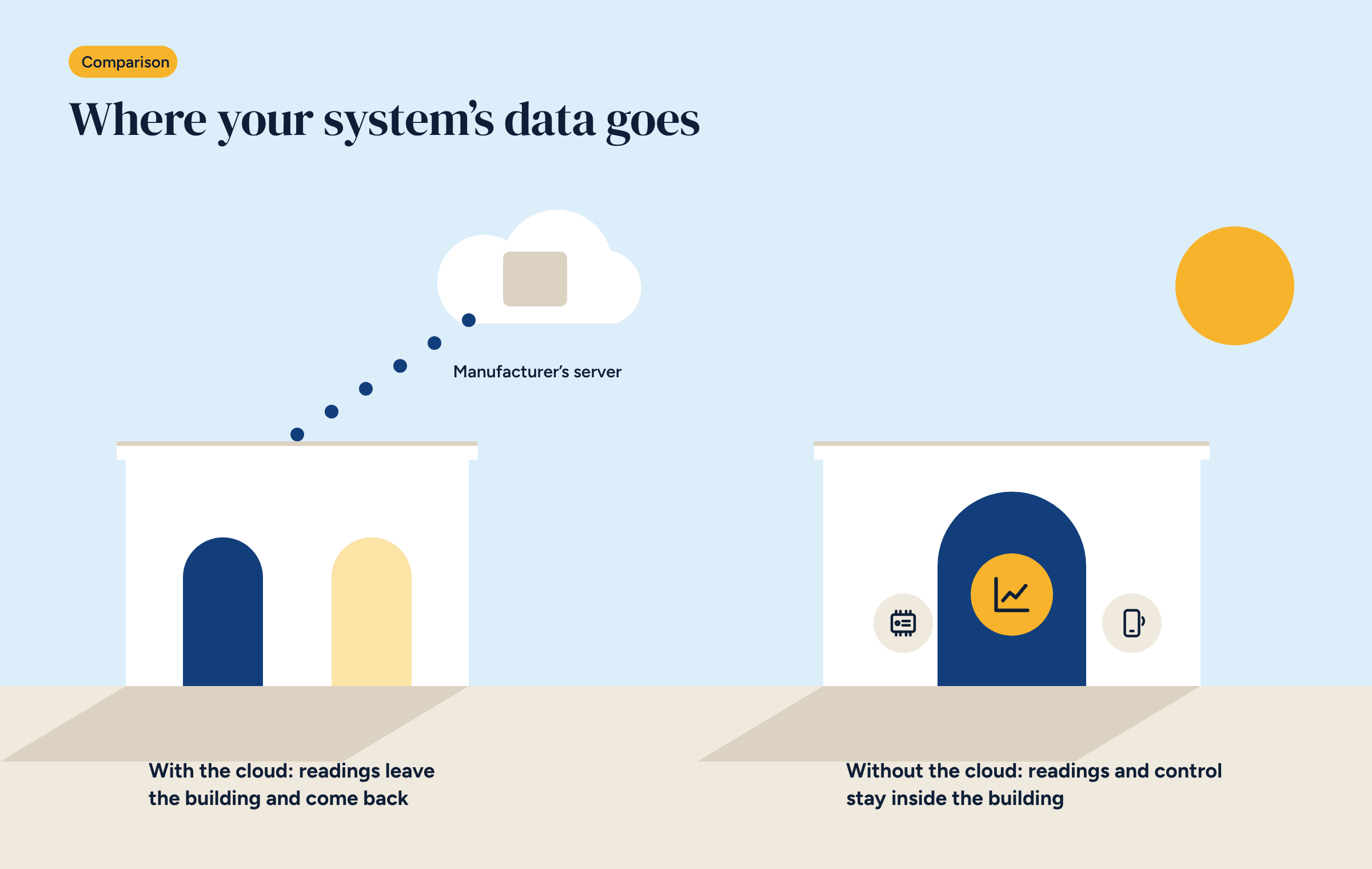
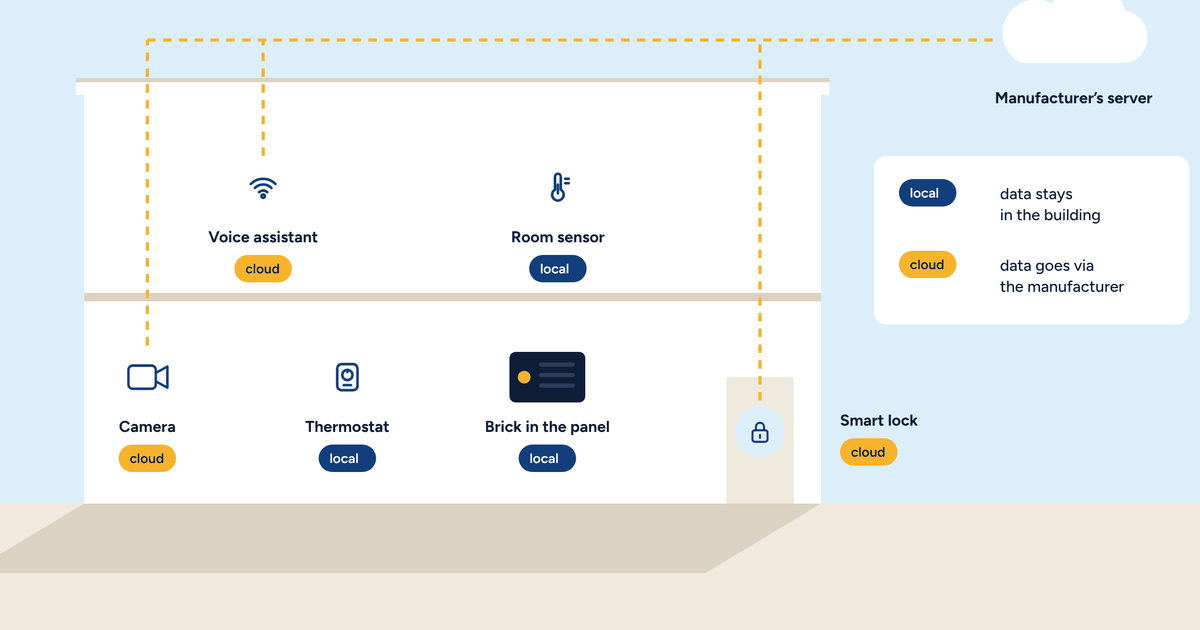
In many consumer systems the brain is not in the house. The thermostat measures the temperature and sends it to a server; the server decides, applies the schedule and sends the command back. The app on your phone is just a window onto that server.
This design has advantages for the seller: central updates, data collection, no need to configure the home network. For the buyer it has three consequences.
This is not a theoretical risk. Some cases became well known.
In 2016 Revolv smart home hubs, bought by Nest, stopped working altogether: the service was closed and the devices became useless. In 2020 Wink imposed a monthly subscription on its users with only a few days’ notice: anyone who did not pay lost their automations. In 2022 Insteon switched off its servers without warning, leaving thousands of homes with devices that no longer responded to the app.
These are American stories from light-duty home automation. But a heating system is more critical than a light bulb and lasts much longer: a manifold and its actuators can stay in place for twenty years. It is fair to ask whether the service controlling them will still exist in ten.
“No cloud” is often misunderstood as “no app” or “no control from outside”. It is neither. It helps to separate two functions.
Local operation. Reading the sensors, deciding when to open a zone, running the heat source, storing the data. This has to happen inside the building, always, with or without the internet.
Remote access. Checking temperatures from your phone, changing a schedule while travelling, receiving an alert. It is convenient, and it can be done without a third-party cloud, through a secure direct connection to the system.
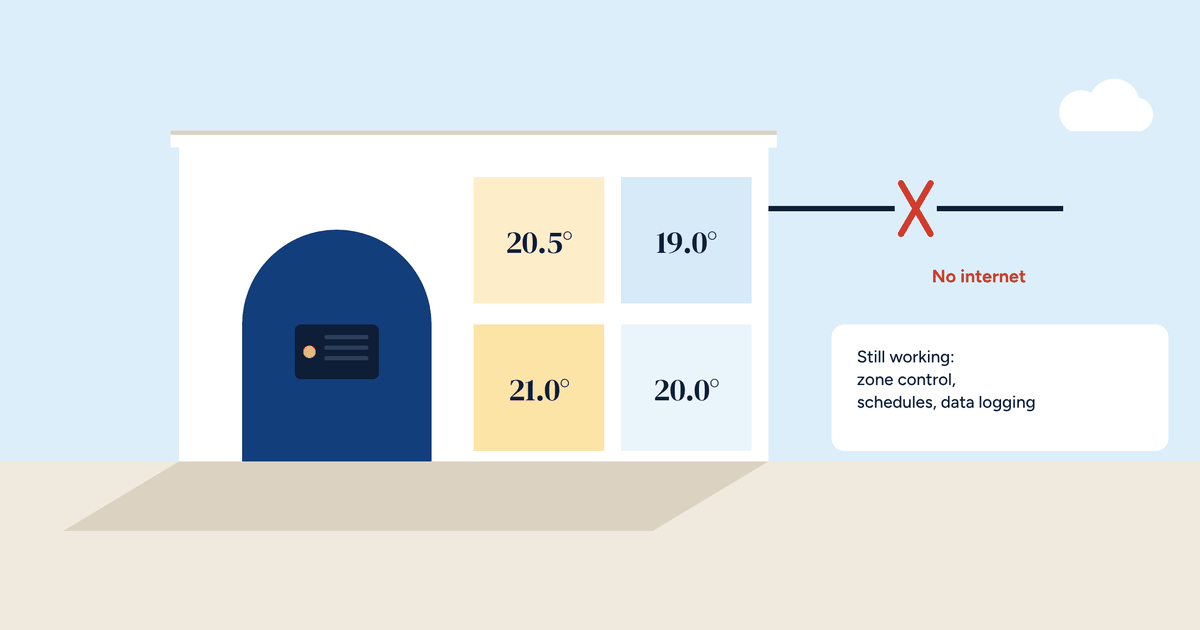
A well-designed system keeps the two apart: if the internet goes down, you lose access from outside, not the heating control.
Brick is built on this principle. The controller sits in the panel and does all the work locally.
Access from outside is added if needed, through a virtual private network or a dedicated router, and the keys stay with the owner and their installer.
A common argument for the cloud is security: big manufacturers’ servers are run by specialists, constantly updated and better protected than a home network. That is partly true. But a cloud system also adds points of attack: an account with a password, a server holding the data of thousands of homes at once, an app that must be able to reach the system from the internet. When a service like this is breached, the data exposed belongs to every customer, not just one.
A local system shrinks the exposed surface. If the system cannot be reached from the internet except through a private network, an attacker first has to get into the building’s network. That does not make a local system secure by definition: it still needs strong passwords, a separate network for the system and planned updates. But those measures depend on whoever runs the system, not on a distant supplier.
Then there is continuity. A cloud server can be unreachable because of a fault, a connection problem or a business decision. A controller in the panel depends only on the building’s power supply, just like the boiler it controls.
Whether you choose Brick or another system, ask the seller five questions before buying a thermostat or a control system.
For offices, schools and hotels the same questions weigh more. A public body cannot depend on a foreign service that changes its terms. A hotel cannot be left without heating because a server is unreachable on a Saturday in January. And in both cases occupancy data, which is easy to infer from temperatures, is personal data: whoever processes it must know where it is stored, for how long and who can access it. With a local system the answer is simple, because the data stays on a controller in the building.
For these buildings, home automation without the cloud is not a technical preference: it is a condition for keeping control of your own system. We will cover remote access and data in the next articles in this category.
Control, data and app all run locally, with no mandatory cloud and no subscription. Remote access is added only if you need it.