Measured energy

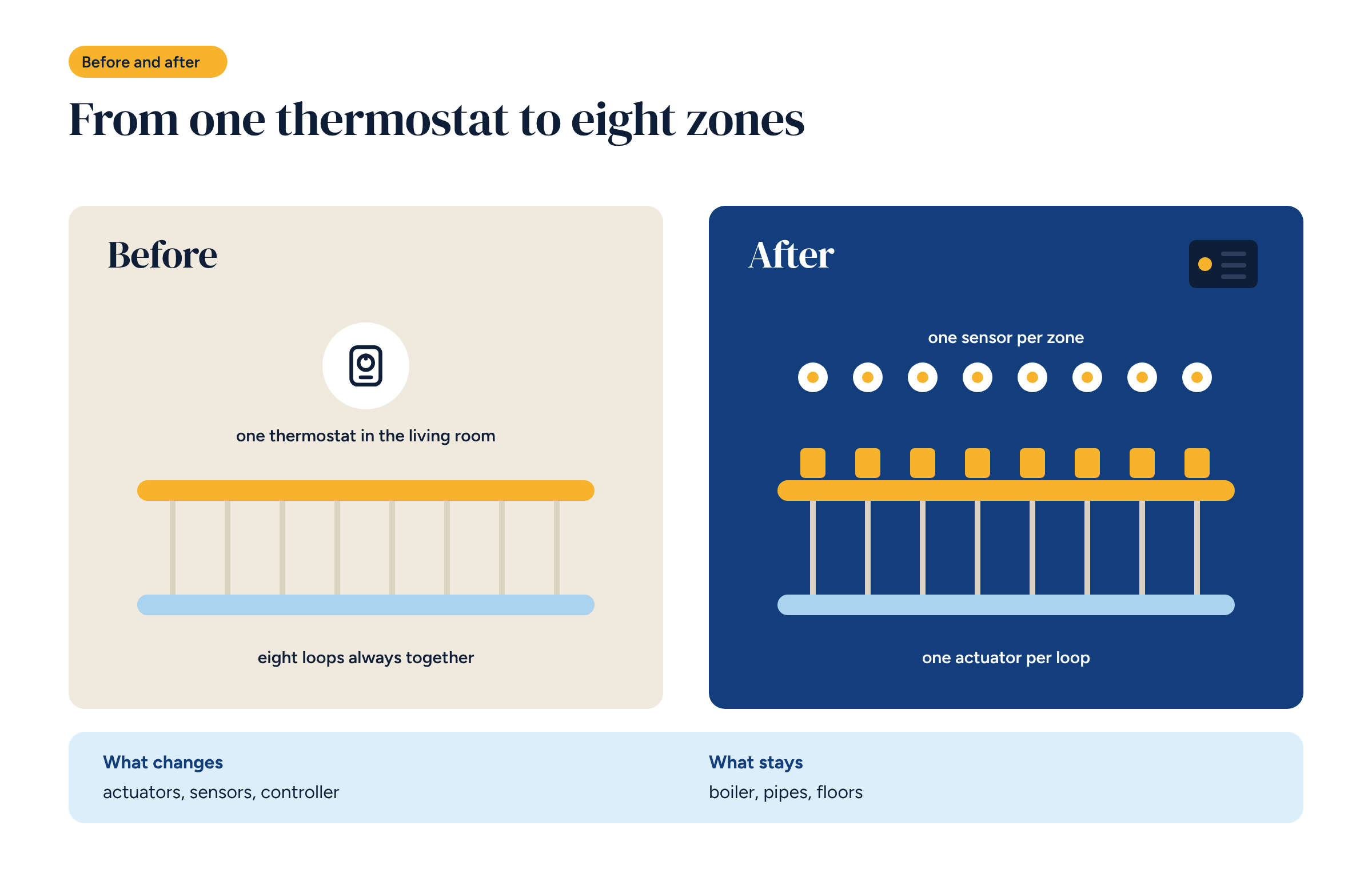
In many homes the underfloor heating already has a manifold with one loop per room, but a single thermostat controls them all. Retrofitting zone control is a few days’ work, not a renovation.
It is a common situation: a home or small office with ten- or fifteen-year-old underfloor heating, a manifold with a loop for each room and a single thermostat in the living room. Every loop opens and closes together. The north-facing bedrooms are cold, the sunny study is too warm, and in summer the story repeats in reverse.
The good news is that a retrofit of zone control on existing heating does not mean replacing the system. The pipes in the floor are already there, and so are the separate loops. All that is missing is a way to control them one by one.
Before proposing any work, look at three things.
The manifold. How many loops it has and which rooms they serve. The loops are often labelled, sometimes wrongly. If the loops are already prepared for actuators, meaning the valves have the thread for an actuator head, the job is much simpler.
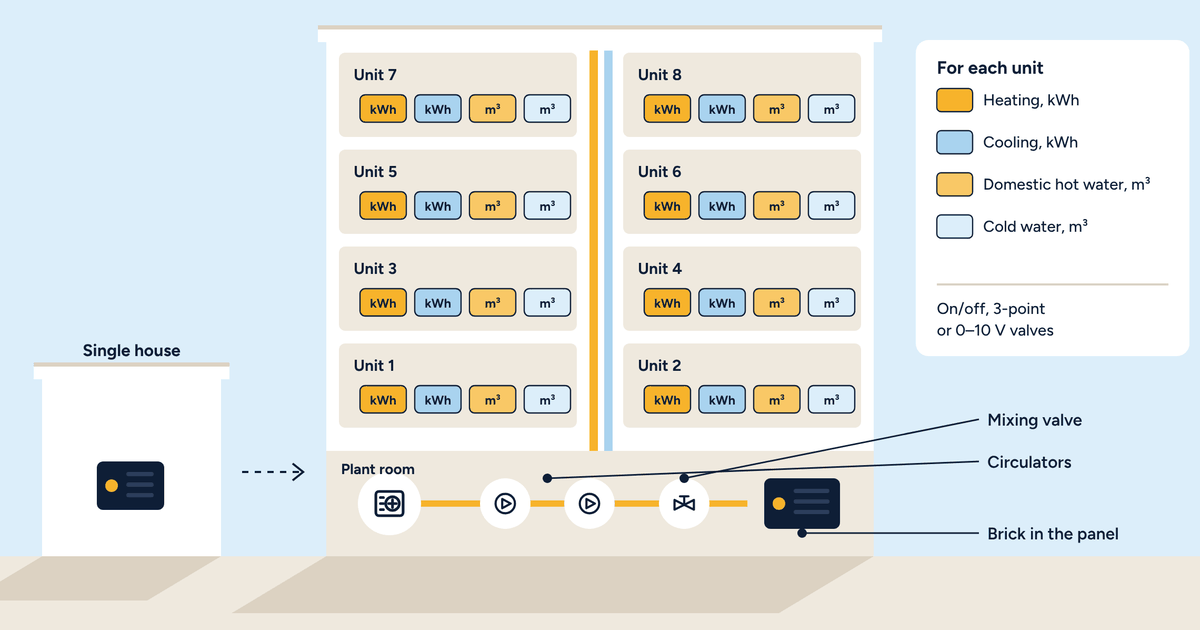
The plant room. What heat source there is, whether there is a mixing valve, where the underfloor pump sits, whether there is an outdoor sensor. This tells you how much of the plant room is worth bringing under the new controller.
How the rooms are used. Who lives there, at what times, which rooms stay empty for days. This is what decides how many zones are really needed. Eight zones in a house where everyone lives in the living room is a cost with no return. As we saw in the article on zone control savings, the benefit is large in uneven homes and small in the others.
The upgrade touches three elements.
Actuators on the loops. They fit onto the manifold valves, one per loop. If a room has several loops, its actuators are switched together. Thermoelectric actuators are wired back to the panel; wireless Zigbee ones need no cables, but check that they are compatible with the manifold valves.
Sensors in the rooms. One per zone. In a retrofit, wireless sensors are nearly always the right choice: they stand on a shelf or stick to the wall with tape, about one and a half metres above the floor, away from windows, radiators and direct sunlight. No chasing walls, no dust.
The controller. It replaces the old thermostat as the brain of the system. It reads the sensors, drives the actuators and, if you also connect it to the plant room, runs the pump, the mixing valve and the heat demand to the boiler or heat pump. This is where the zones stop being eight separate thermostats and become one coordinated system.
In practice the whole job happens between the plant room, the manifold and the walls where the sensors go.
For a home with up to eight zones the work usually takes two or three days, with the heating off for only a few hours.
The best time is autumn, before the system runs flat out, or spring. It can be done in mid-winter too: the downtime is short and the floor, with its thermal mass, does not cool down that quickly.
After handover, plan a check two or three weeks later, looking at the temperature charts for each zone. That is the moment to fine-tune schedules and the curve, as explained in the article on weather compensation.
The same mistakes come up again and again in upgrades, and they could almost always have been avoided.
Each room has its own temperature and its own schedule. The children’s room warms up before they wake, the study only on days spent working from home, the guest room stays at set-back until it is needed. The app shows the temperature of every zone and a schedule can be changed in seconds.
And there is a less visible benefit that matters: for the first time you can see how the house behaves. Which rooms struggle to warm up, how hard the heat source works, how consumption changes from month to month. That is the data you need to decide the next steps, from replacing the boiler to insulating a wall.
The case we meet most often is a house with four rooms and a single thermostat: the living room is too hot, the bedroom is freezing. After the upgrade each room gets its own temperature and Brick controls them one by one, coordinating them with the boiler or heat pump. The people who live there feel the difference within the first week.
The Brick configurations designed for this case are B1 and B2, for up to 4 and up to 8 zones, with wireless sensors and actuators and control from the app. If the rooms already have wired thermostats you want to keep, configurations A0 and A1 start from those.
With a photo of the manifold and the plant room layout we can tell you how many zones make sense and which Brick configuration you need.